Why Fight

Why Fight

by “maadhav”

a few times some one here said something like, “fight if you want to fight but do not fight in the name of religion, or do not say that the religion says to fight.”

so, let me address the issue here. first let me define ‘religion’ and ‘dharma’. islam, ., judaism, are religions. hinduism is not. hinduism is dharma – eternal.

islam (koran) cleary says to invade and conquer non muslim countries and convert or kill non muslims. the total history of islam proves that they did nothing but this, and the hindus have suffered the most from islam for 1000+ years.

. also is not comfortable with any other religion on this earth other than .. xians are very aggressive and organized to wipe out all the cultures of the world except . from the face of earth. previously they did go to wars for that. now they use political and money power to achieve that end. xians say there is no soul in animals and non human lives. . is focused on possessing and exploiting this earth and its people. . says we all are sinners and anything other than the bible is devils work. so to them gita is devil’s work.

hinduism (sanatana dharma or varnasrama dharma) is not like islam or . that are with a set of beliefs. hinduism is about the truth, eternal truths about god, us, and his creation. krishna shows all possible ways, scientifically, how one can go to him. hinduism is not an organized dharma, that is, hindus do not have any interest to convert the whole world to hinduism. this is because krishna says in gita to not tell any one about dharma if one is not interested or is envious to krishna.

so, basically, hinduism is inherently tolerant to all and the religions are not. this tolerance however has a limit. adharma cannot be tolerated.

when arjun, all of a sudden on the battle field of kurukshetra, decided to tolerate adharma, krishna said him in gita to fight, even with the great souls like drona and bhishma. no one should miss to understand this fact.

so, you can see here why hindus fight.

the reasons why hindus fight is totally different from why muslims or xians fight. dharma is not a ‘religion’.

so, if you understand this,then you can see that islam and . will go to wars for religion, because their books say so.

hindus have no choice but to fight with adharmis because krishna says so. it is dharma to fight asuras.

this brings to another point:

some say, “fight with asuras only if you are a pure kshatriya.” mostly the HK’s say this to the hindus.

so, this implies the HKs are “pure” brahmanas.

so, then it is the duty of pure brahmans to raise pure kshatriyas. brahmans are the ‘head’ of a vedic society.

like drona and chanakya muni, the HK’s need to be expert not only in shaastras, bur also shastras – the modern weapons and the art of war. then they must teach dharma of kshatriyas and teach how to fight to win over the asuras.

to win over the asuras, you need to know your enemy and their ideology well. if you give free political field to the asuras, then they will rule over the suras and you.

therefore, the pure brahmanas must enter politics and place suras in political positions.

this activity of raising pure kshatriyas

cannot happen by slandering and fighting with the hindus.

be one of them, and encourage them to become pure kshatriya by example, as krishna has said to do.

you need to learn and practice and preach chanakya niti also.

also remember that HKs’ freedom to do bhakti is protected by kshatriyas only, no matter how impure they are.

so, realizing the fact that the asuras have raised hell (terrorism) every where, the priority of the time is to fight and win over the asuras and kill their ideology (intellectual fight).

so, the bottom line is:

those who follow a ‘religion’ do fight with infidels.

those who follow dharma have no choice but to fight asuras and win over them.

there is no shame in saying, “i will fight asuras because krishna says so in gita.” if the “pure” brahmanas do not expose the asuras and encourage the kshatriyas to fight, then they will do a great dis-service to the society.

jai sri krishna! -maadhav

“yuddhAya krita nischaya…” – Krishna


Introduction to Sanatan Dharma

Introduction to

Sanatana Dharma (SD)

(The Eternal Religion) whose incorrect name is Hinduism

Written for the High School and College Students of the West

by Suresh ‘Vyas’
1/1/1998
==================================

Preface

 Hindu is a wrong name of Vedic people whose culture grew in Bharat (India) on the East of Sindhu river and South of Himalayas.  The Muslim invaders pronounced Sindhu as Hindu.  To them, Hindu meant those who lived on the other side of the river Sindhu.  Similarly, the Europeans called Bharat India.  This article will use correct original names.

Rather than knowing SD from non-SD or anti-SD person, more and more students and teachers want to know it directly from real Vedic people and SD preachers.  This is smart, because you could get true knowledge of SD from them only.

Here is some data about SD:

Number of Followers:  More than 900 million people, mostly from Bharat.  It has the 3rd largest following.

Number of Scriptures:  SD has the greatest number of huge scriptures or religious literature.  The root scriptures are four Vedas of 80,000 Sanskrit verses total.  The summary parts of the Vedas are called Upanishads which are 2057.  Of them, 108 are principals.  Then there are 18 Puranas or the history books. Each PuraaN has thousands of verses.  Of these, Srimad Bhagavatam is considered a spotless PuraaN.  Then there are many Smrutis, literature on the six kinds of philosophies, and two great epics:  Ramayana and Mahabharata which has 90,000 verses.  It is the story of a great war that occurred 5,000 years ago in Bharat.

One 700-verse portion in the middle of Mahabharata  is called Bhagavad Gita (The Song of God).  It is the summary of the 80,000 verses of the Vedas.  Therefore, it is known as THE BOOK of SD.  My guru (spiritual master) A.C. Bhaktivedanta Swami Prabhupada, the Founder-Aacharya of the International Society for Krishna Consciousness (ISKCON) has translated Srimad Bhagavatam and Bhagavad Gita in English.  His books are studied in many USA universities.  He has thousands of disciples all over the world.  His books are also translated in many other languages of the world.  In addition to the above literature, there is literature written in our times by six great Aacharyas (the spiritual masters who practice what they preach and teach by example).

All the original literature is in Sanskrit language.  Now the computer programmers of the world realize that Sanskrit is a logical language and is easily programmable.  In a Sanskrit sentence, you could put words in any sequence, and the meaning does not change at all.  Obviously, the Vedic culture which developed such an efficient language and such a vast religious literature must be highly advanced intellectually.

The way of Preaching:  The world has never seen a Vedic preacher knocking doors to preach.  The Supreme Personality of Godhead, Krishna, in Gita says, ‘This is confidential knowledge for coming to Me.  Do not impart it to any one who is not interested or is envious to Me.’  Some great Aacharyas, however, are so compassionate to others that sometimes they do preach to uninterested.  Islam, on the opposite end, says, ‘Convert all the people of the world, even by brute force if necessary, or kill them if they refuse or resist.  By doing so, you would go to heaven.’  Christians also have used brute force, particularly in South America, to spread religion.  This is not the way of the Vedic people.  Sanatana Dharma is spread because it is attractive to all types of people, particularly the intellectuals.  Not only that, it has survived diabolic acts of Islam, over last 1,000 years, of mass killings, destruction of thousands of temples and libraries and learning centers in Bharat.  The holocaust of Hitler is very small compared to what the Vedic people have suffered.  Still, Sanatana Dharma is spreading.  Unless it speaks of the eternal truths, this could not be possible.  No doubt, Bhagavad Gita gives complete science of spirituality, say some world scholars.

Content

The Origin Of SD

The Concept Of Time

Predictions

The Concept Of Space

The Technological Advancements

The Concept Of The Supreme God

Concept Of Demigods

Analysis Of A Living Entity

Why We Are Here In The Material World?

The Purpose Of Living

The Concept Of Maya (Illusion)

The Theory of Karma

The Ways Of Going Back To Godhead

The Four Main Yoga’s

Control Over The Senses

1.  The Origin Of Sanatana Dharma

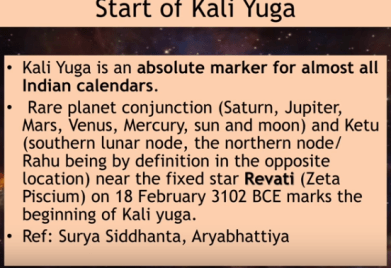
The Supreme of Godhead himself gave the knowledge of the Vedas to the first living being, demigod Brahma, in the beginning of the this creation.  This knowledge has come down to us through bona fide disciplic successions.  In the ancient times, there was no need to write Vedas because people used to keep it in their memory very easily.  Vyasadeva, a literary incarnation of the Supreme God, call it Krishna or Vishnu, wrote it the first time 5,000 years ago for our benefit because he knew that we people in the next Kali millennium would not have much ability to remember.  Kali started when Krishna left this world about 5,000 years ago.

2.  The Concept Of Time

The smallest unit of time used by the Vedic people was called a Truti.  The other units were:

100 Trutis    =    1 Vedha
3 Vedha      =     1 Lava
3 Lava         =    1 Nimesh
3 Nimesh     =    1 Kshana
5 Kshana     =    1 Kashtha
15 Kashtha  =    1 Ghadi
2 Ghadi        =   1 Muhoorta (= 1 Hour)
3 Muhoorta  =   1 Prahara
4 Prahara     =   1 day or night
360 days      =   1 Varsha (= 1 year)

432,000 x 1 years = 1 Kali yuga
432,000 x 2 years = 1 Dwapara yuga
432,000 x 3 years = 1 Treta yuga
432,000 x 4 years = 1 Satya yuga

One cycle of Satya, Treta, Dwapara, and Kali = 1 Maha yuga.

71 Maha yuga  =   1 Manvantara
14 Manvantara =  1 Kalpa  =  1 Day of Brahma
360 days of Brahma    = 1 Year of Brahma
100 Years of Brahma  = 1 Maha Kalpa  = 1 Breath of Maha Vishnu

Time Cycle:

Per the Vedic scriptures the sequence is this:

Satyug, Tretayug, dwaparyug, Kaliyug, Satyug, Tretayug, dwaparyug, Kaliyug, …

The sudden great change from Kaliyug to Satyoug is only possible by kalki Avatar.

Per Yukteswar Yogi the time sequence is:

Downward process: Satyug, Tretayug, Dwaparyug, Kaliyug, then

Upward process: Kalki, Dwapar, Tretayug, Satyug .. ..

The gradual change is possible by great spiritual Vibhuutis. This is like if you want to go up, you need to go one step up from wherever you are on the ladder; and if you want to go down, you need to go one step down from wherever you are on the ladder.

There is a similarity in lief and gravity. Due to gravity every ditch, no matter how small or big, it will be filled gradually over time.  Similarly, in life, if a person does not make effort to rise spiritually (meaning does not control his/her senses by regulative dharma principles) then he will keep falling spiritually (meaning will keep doing more and more sinful activities that will harm him and the society as well.)

Below video includes info about the Vedic yug cycle.

3.  The Predictions:

Bhavishyat PuraaN full of predictions.  Srimad Bhagavatam in its final chapters predicts that Krishna would incarnate as Buddha.  He did, 2000 years ago.  The next predicted incarnation of Krishna is Kalki at the end of Kali.  The kind of culture we see now is all predicted in there clearly.

4.  The Concept Of Space:

Three quarters of the total creation of God is called the spiritual world.  The rest, one quarter, is this material world within our sky with its galaxies, stars, suns, moons, and planets.  The spiritual world is beyond this material world which is dark, and that is why God has created suns and moons so that we can see.  The spiritual world is self illuminating and has spiritual planets.  A lot more spiritual living beings live there.

5.  The Technological Advancements:

Space travel, consequences of the theory of relativity, all kinds of weapons much more advanced and destructive than we have now, counter weapons, voice operated airplanes, etc. is described in Mahabharata and other scriptures.  To Vedic people, no technological advancement is new.  It is new in our time only.

6.  The Concept Of The Supreme God:

The Supreme God is only one, otherwise the word supreme has no meaning.  He can be realized by any human in three ways:

1) as Brahman which is formless, sexless, without any qualities, impersonal.  it is described as sat (eternal existence) chit (supreme consciousness), and aananda (bliss).

2) as Paramatma within one’s heart as the Supersoul along with the Soul in the bodies of all living beings. He just looks at the Soul and witnesses everything the Soul thinks, speaks, and does.  He is one, common in each living being, and

3) Bhagavan, the Supreme Personality of Godhead, which is known as Krishna, Vishnu, Mahavishnu, etc.  He is the supreme controller and cause of the causes.  He incarnates as Brahma to create, as Vishnu to maintain, and as Shiva to destroyer.  Bhagavan the almighty God who is the controller of all opulence, power, fame, beauty, and renunciation, says Swami Prabhupada.  He is a person full of all the qualities and forms.  He loves His creation and each living being.  He especially loves those who love him or remember Him or want to come to Him.  He provides extra help to them.  His forms, abode and past times are described very vividly in scriptures like Brahma samhita, and Srimad Bhagavatam.  Whenever there is decline of religion and advent or irreligion, He incarnates in the material worlds mainly to protect and please His devotees.  Then, as His secondary activity, He also annihilates the miscreants who give troubles to His devotees.  He is unborn and never dies.  He never gets old or sick.  He is everywhere, knows everything of the past, present, and the future.  He can appear in person before any one who qualifies, and can communicate like any other human being.

7.  The Concept Of Demigods:

The principal demigods are three, Brahma, Vishnu, and Shiva as described above.  Vedic people worship Vishnu or Krishna, Shiva (a son of Brahma), Goddess Durga (or Uma, wife of Shiva) which is the material energy of Krishna, Ganesh (the elephant-headed son of Shiva, and the Sun God.  In addition, they also worship Lakshmi (the goddess of money and wife of Vishnu,) Saraswati (the goddess of knowledge and daughter of Brahma,) and nine other goddesses which are different forms of Durga.  The forms of all demigods and goddesses are very beautiful, but goddess Kali’s form is black, and ferocious.
Each demigod or goddess serves Krishna, the Supreme Personality of Godhead.  They control various planets and carry on various functions and control the various natural laws.  Each demigod has special power to give special benediction.  Lakshmi gives money to her devotees, Saraswati gives knowledge to her devotees, Ganesh gives success in religious endeavors of his devotees, Hanuman, the monkey-god gives willpower to curb sex drive and strength to body and knowledge of Rama (Krishna) to his devotees, etc.  Whatever benedictions the demigods give are actually given by Krishna.  Demigods are like human beings, but with very much physical and mystic powers and very long lives.  They live on their own planets in this material universe.  They too die and re-incarnate like humans.  The Puranas describe how demigods have fought with each other and how Vishnu finally ends the conflicts.  This is always happening on various planets in various universes.

8.  Analysis Of A Living Entity:

A living being has a body made of five great material elements: earth, water, air, fire, and sky.  In the language of Physics these are five states of matter: solid, liquid, gas, plasma, and sky which is void and ether or electromagnetic medium which pervades every where in space.  A body is born, constantly changes, gets diseases, could gets cured, and ultimately dies.

Within a body is a Jiva or subtle body made of mind, intelligence, ego, and the Soul of the living being with the Supersoul called Paramatma which is common in each living being.

The mind, intelligence and ego are described as material, but the Soul and Supersoul are spiritual, non-material.  Just as light is spread everywhere from the Sun, consciousness is spread everywhere in the body from the Soul.  The size of a soul, living spark, is described as 10 thousandth part of the tip of a hair.  It resides in the heart along with the Supersoul whose size is that of a thumb.  A soul is qualitatively same as the Supersoul, but quantitatively its powers are very less compared to the Supersoul or God.  Like God, a soul never dies.  It is described as a part and parcel of God.

The business of mind is to make various desires and receive thoughts.  Mind is very swift.  It can go from one desire to another, one thought to another, with the speed of light.  Mind’s natural propensity is to wander swiftly, but it could be made steady by constant practice and detachment, says Krishna.  The purpose of Yoga is to make the mind steady and focus it on God.

The business of intelligence is to figure out right form wrong and good from bad.  The ego says, “I am this or I am that,” like: “I am American, white, black, student, teacher, president, boy girl, woman, man, etc.”  When some one asks you who you are?  The answer comes from your ego.  Their intelligence could change from fool to wise or wise to fool.  The scriptures and SD is meant to make us more and more intelligent and wise, spiritually.

Most people have an ego which is based on the body.  Therefore, it is called a false ego because body is not permanent and is material.  Our true ego, SD says is that we are the souls, part and parcels of God.  We have an eternal loving relation with God, Krishna, which we have forgotten.

9.  Why We Are Here In The Material World?

As the servants and devotees of Krishna, we, the souls were once in the spiritual world with Him in perfect harmony and blissful state like many may others who are there.  Because God loves all souls equally, He gives all freedom to each soul.  Some souls there think, “God controls everything and enjoys everything.  I am like God too.  So, why not I control the material energy and enjoy myself?”  Thus, they desire to enjoy independent of God.  This, however, says SD, is not possible unless one forgets Krishna.  So, Krishna’s Maya, the illusory energy makes them forget Krishna so that they can fulfill their desire.  This gives them a birth in the material world with a material body.

Swami Prabhupada says that this material world is like a prison.  The souls who desire to exploit the material energy and enjoy with their senses independent of Krishna are sent here from the spiritual world.  Thus they are called fallen.  God and His demigods maintain law and order in this prison, but because we have made unspiritual desires, we cause troubles in the prison.

10.  The Purpose Of Living:

Some prisoners, the souls in this material world, come to realization that they do not belong here, that they made a wrong desire to enjoy independent of Krishna.  They then desire to go back to their original home, back to Godhead, Krishna.  Then Krishna’s agents in the prison help them.  Thus they go back to godhead soon.

Of all the living beings, only humans can understand God with their intelligence, His creation, purpose of life, etc.  Therefore, only they are capable of going back to Krishna in the spiritual world.  The purpose of human life is to go back to Krishna.

11.  The Concept Of Maya (Illusion):

Maya is the  illusory energy of Krishna that makes a soul forget Krishna so that the soul could go ahead per his desire to exploit the material energy of Krishna independent of Him.  It conceals the truth from us, and we perceive something other than the truth.  It is under the control of Krishna.  So, if we surrender to Krishna, Maya could not fool or bewilder us.  It binds us by its three gunas (modes or ropes):  Satva (the mode of knowledge), Rajas (the mode of work), and Tamas (the mode of ignorance).  At any given time one mode is predominant in us.  These modes compete among themselves to influence over us.  We always are under the influence of a mix of any amount of these three modes.  The true purpose of life, says SD, is to constantly struggle against Maya and ultimately become independent of Maya.  The purpose is to raise ourselves from Tamas to Rajas to Satva, and ultimately go beyond Satva.  Then we free ourselves from the clutches of Maya, we become Gunatitas.  Then we qualify to go back to godhead.

12.  The Theory of Karma (Action) and Re-incarnation:

This describes a law of Prakriti (nature).  Everyone does something at any moment.  It is not possible to stop acting.  Generally, if we do good, we get good/ pleasing result.  If we do bad thing, we get in trouble.  We get reward and punishment in fair proportion to our good or bad actions.

A soul never dies.  In the material world, Prakriti (nature) gives the soul a body suitable to fulfill its desires.  All souls in the animal and plant life once had a human body.  It was their chance to use their intelligence and go back to godhead.  Instead, they choose to live like an animal or demon.  Therefore, as a result of their karma, their desires to enjoy food, sleep, defending, and sex only as animals do, nature prescribed them a series of births in non-human lives.

Animals live by instinct, not by spiritual intelligence.  Therefore, there is no sin for whatever they do.  In the animal and plant lives, they enjoy as they desired, but they suffer too, because miseries of birth, death, old age, and diseases could not be avoided in the material world.  Once they pass through a series of births forced upon them by nature, they again get a human birth.  Thus again they get a chance to use intelligence and learn how to go back to godhead.

Whatever a living being enjoys or suffers is because of the results of its past actions, even of previous lives.  Krishna loves all souls, and He also controls the nature.  Therefore, even if one has committed so much sins, but if one surrenders to Krishna, He could destroy one’s past sin’s bad reactions instantly.  Krishna, always being along with each soul as Paramatma, knows all the previous births of a soul and one’s all acts in each.  Most of us do not remember our past lives.  Whatever one remembers at the time of one’s death, one gets the next birth accordingly.

https://youtu.be/AvCsn-EDS5o?t=344

13.  The Ways Of Going Back To God:

Death is certain, but no one knows when it will come.  So, if we remember Krishna and think of going back to him constantly, then we would be thinking that too at the time of our death.  Then Krishna says, we go to Him.  Whatever we remember in most of our lives, whatever our strong desires are, that we remember at the time of death which may be painful.

In Vedic culture, the social system given by Krishna is such that each person has opportunity to go back to Him.  This system is called Varna-aashrama Dharma.  This is also another true name of SD.  The society is divided in four classes of people:

1)  Brahmins or the intellectuals.  They study and teach the Vedas and other religious scriptures.  They are the spiritual guides to the society.

2) Kshatriyas or the protectors.  They maintain social law and order within and from without so that all other classes of people could execute their duties as prescribed by Krishna.

3) Vaishyas or mercantile.  They do farming, cattle keeping for milk, etc., and merchants, and

4) Shudras or laborers.  They do manual service to all the other classes.
A class for a person is decided not by his birth but by his qualities and actions.  Krishna and scriptures describe in detail how these classes should conduct their duties.  Krishna says, by performing duties as prescribed, one goes back to Him.

Life given to humans is of 100 years, generally.  SD says, one should do four activities in life:

1) Dharma. Study religion and what one’s duties are.  This is done from age 5 to 25 in a  Gurukula where one lives with a spiritual master and serves him and learns from him.

2) Artha . Earn living according to one’s natural tendencies or as advised by one’s guru.  This is done from age 26 to 75.

3) Kama. Get married and gratify the senses as prescribed by the scriptures, from age 27 to75.  Sex indulgence out of marriage is prohibited.  Sex indulgence within marriage is allowed only when one wishes to raise God conscious children and is capable of raising, and

4) Moksha.  This, going back to godhead, getting out of the cycle of births and deaths, raising one above the three modes of material nature, is the ultimate goal of life.  All the three previous activities are for to get this.

Life of a human has four phases depending upon age:

1) 5-25:  Barhmacharya Aashrama (phase).  In this phase, one studies and observes celibacy.

2)  Grihastha Aashrama.  25-50:  In this, one enjoys married life, earns money, raises god conscious children.

3) 50-75: Vanaprastha Aashrama.  In this, one retires from family life and lives in nature as prescribed.

4)  75 to end:  Sanyasa Aashrama.  In this, one completely withdraws from worldly life and lives a complete spiritual life with just minimum necessities.  They become the highly respected preachers of the society.   Thus, SD prescribes how one in each Varna should live in each Aashrama.   The spiritual intelligence goes down from Brahmins to Kshatriyas to Vaishyas to Shudras.  Therefore, a higher Varna usually is more strict in living according to scriptures.  More one abides by SD, more one is respected in society.

14.  The Four Main Yoga’s:

Yoga means to join, with the supreme god, Krishna.  One chooses a yoga depending upon where one’s strength is.  The result, or goal, ultimately is the same, Moksha.

1)  Some people are more action oriented.  They mostly think, “What do I do?”  They usually prefer Karma yoga.  Krishna says,  “Whatever you do, do it for Me, and do not aim for results.  Just do it because it is right thing to do for me.”  This is karma yoga.

2)  Some people have a lot of brain power.  They usually prefer Gyana yoga.  They study about god and his creation.  They ask who am I, why am I here, etc. Births after births they keep on studying and developing intelligence.  Krishna says that after many births a Gyana yogi becomes a Bhakti yogi.

3)  Some people are men of heart, very emotional.  They usually prefer Bhakti Yoga.  They fall in love with Krishna.  Then they cannot help but do everything to please Krishna.  Krishna says that of all the yogis, a Bhakta, a devotee,  is most dear to Him.  Bhaktas are of two kinds:  a) A Sakama Bhakta worships Krishna because he wants something from Him.  b) A  Niskama Bhakta  worships Krishna because he knows that Krishna is worshipable.  He does not want anything from Him.  He loves Krishna so much that he does not want to give Him any trouble.  Such Bhaktas do not care for even Moksha.  They want is to have the opportunity to serve and glorify Krishna and His devotees.  This is the highest form of Bhakti.  It usually comes after some sakama bhakti.

4)  Some, very few, people are good at controlling mind.  They prefer Dhyana yoga.  They constantly practice controlling the wandering mind and focus it on Krishna.  When they become able to do it by practice and by detachment, they feel bliss when they are in that  Samadhi  condition when the mind stays steady on Krishna like a flame of a lamp in a room without any air movement.  They get some supernatural power because of this accomplishment.  If they misuse it, however, they fall down spiritually and suffer eventually.

15.  Control Over The Senses:

Any  yogi, anyone who wants to go back to godhead, needs to keep his senses in control.  The senses of knowledge: eyes, ears, nose, tongue, and sense of touch are engaged in acquiring knowledge and understanding of Krishna and His past times.  The senses of action are engaged in the service and glorification of Krishna and His devotees.

16.  Some Vedic Views and Prayers:

    • Parents, teachers, and gurus are revered as demigods.
    • The whole world is a family.
    • O God, lead us from darkness of ignorance to the light of spiritual knowledge, from all the untruths (relative truths or partial truths) to the Absolute Truth.
    • A mother, the earth, a king’s wife, teacher’s wife, guru’s wife, elder brother’s wife, and a cow are all treated as one’s mothers.  One should walk softly on the earth and never mistreat a cow.
    • One should respect other’s sadhana (practice of going back to godhead), but should not deviate from one’s own sadhana.
    • One should always give up (control) lust, anger, greed, and passions.
    • One should not give up sacrifice, charity, and austerity.  Chanting the holy names of Krishna is called Japa sacrifice, and it is the easiest recommended way in this Kali yuga to go back to godhead.
    • One should take every opportunity to read or listen scriptures.  One should use one’s talents of music, dance, and arts in the service of Krishna.
    • A serious sadhaka should avoid meat eating, drugs including tea, coffee, coke, etc., gambling, and illicit sex.  Then it becomes easy to move from Tamas to Rajas to Satva and above Satva guna.  Controlling lust, anger, greed, and passions also becomes easy.  The brain and intelligence develop so nice that it becomes easy to understand spiritual knowledge and Krishna.
    • One should eat, sleep, and work moderately.
    • Only the truth prevails.
    • Speak truth, speak pleasing.
    • Body is a tool to practice religion and thus go back to godhead.  We are not the body.
    • In the universe, there is unity in variety.
      Just as physical laws are universal, the spiritual laws are also universal and absolute.  They do not change or stop affecting whether you believe them or not.  Because, those who know these laws can see how much spirituality there is in any one’s actions, no matter which religion one follows.  Ultimately, what matters is what you do with your body, mind, and intelligence, no matter what religion you say you follow.

Holi Drama

Holi Drama
by S. Vyas

Scene:  Hiranyakashipu doing tapa.

Hiranyakashipu keeps on chanting: “Om namo Brahmaya!”

Brahma:  O Hiranyakashipu, stop you tapa.  You have been doing this tapa since many many years without eating or sleeping.  Your body has been eaten by ants and still you have kept on doing tapa.  I, Brahma, the creator and the giver of boons, am pleased with you.  Tell me what you want.  I will give it.

Hiranyakashipu:  O Brahma, make me immortal and powerful.

Brahma:  I am sorry, I cannot make you immortal, because I am not immortal my self.  So, ask for some other boon.

Hiranyakashipu:  Hmmmm.  Let me think.  OK.  Give me boon that I could not be killed by weapons, I could not be killed by man or animals, I could not be killed in the house, I could not be killed out of the house, I could not be killed in day, I could not be killed in night.  I could not be killed on earth. I could not be killed in sky.

Brahma:  tathaastu!  So be it!
——————————
Scene:  Hiranakashipu with his soldiers.

Hiranyakashipu:  O my soldiers, I am Hiranyakashipu, your king.  I am the mighty king of the whole world.  Remember that I have done severe penance.  Therefore, Brahma has given me such a boon that I could not die.  He did not want to make me immortal, but I tricked him.  He has given me a lot of powers also.  Now I am strong and powerful to destroy Vishnu and worshipers of Vishnu.
Vishnu is my greatest enemy.  He took the form of a boar, took away the earth, and killed my dear brother Hiranyaksha.  Now I am more powerful than Vishnu.  Therefore, stop the people of the world from worshipping Vishnu and force them to worship me.  Go and destroy those who are doing austerity, penance, yagna, svadhyaya, vratas, and charity.  Go to the countries where there are brahmanas, cows, Vedas, varnas, asramas, yagnas, etc. and burn those countries to ashes.  Cut down all trees used in yagnas.  When you destroy all these, Vishu and His bhaktas will loose all the power.  Then force them to worship me.  Go!  Go!!

Soldiers:  Yes mighty king, we will go and do as you said.  (going.)
——————————–
Scene:  Demigods on earth in disguise of ordinary people.

Varuna, Agni, etc. demigods:  O Indra, ever since Hiranyakashipu started his demoniac activities we have left the heaven and are living on earth in disguise to see what is happening.  We have seen that the demon has destroyed Vishnu worshippers and everyone is worshipping the demon.  He is very powerful and everyone is afraid of him.  He is even more powerful than us.  We are helpless against him.  So, we suggest let us to Bhagavan Vishnu and ask for his help.

Indra:  O demigods, what you said is true.  Let us go and pray Vishnu for his help.  [Going to Vishnu and praying.]

Demigods:  O Vishnu, you are the protector of everyone.  This demon Hiranyakashipu is destroying Sanatan Dharma and your worshippers.  He is stronger than us.  We are afraid of him.  Please save us, the people, and Sanatan Dharma.

Voice of Vishnu:  O best demigods, do not fear any more.  I have known all the demoniac things this demon has done.  I will kill him.  Wait for some time.  Those who become enemy of you demigods, Dharma, Vedas, cows, brahmanas, sadhus, and me, they surely meet destruction.  This demon has become strong due to Brahma’s boon, but when he acts like an enemy of his own son and my devotee, I will kill him.
——————————
Scene:  Prahalada at school with other children.  [School Board reads:  Hiranyakashipu’s School for the Advancement of Adharma.]

Shanda:  Children, be quiet and listen.  I am Shanda.  This is my brother Amarka. We are your teachers.  This is mighty king Hiranyakashipu’s school.  Today’s lesson is:  Do not worship Vishnu.  Worship Hiranyakashipu.  Kill and eat cows.  Now go home and remember the lesson.
——————————-
Scene: Hiranyakashipu’s royal assembly.

Hiranyakashipu:  O respectable demons, My dear son Prahalada had is first day in school today.  So, I want to know what he has learned in our school.  Guard, bring my son here.

A guard comes with Prahalada.

Prahalada:  Namaskar my dear father!

Hiranyakashipu:  My dear Prahapada, come, come.  Sit in my lap.  Tell me, what you learned in school today?

Prahalada:  Vishnu is the Supreme Personality of Godhead.  Everyone should worship Vishnu and worship cows too.

Hiranyakashipu: Guards, take this boy to his room.  It seem that some Vishu dootas have secretly taught my son this nonsense.  Warn the teachers that no student knows anything about Vishnu.  Our school should only teach that I am God.

Guards:  Yes, your majesty.  [They take Prahapada away.]
——————————–
Scene: Prahalada at school.

Shanda:  Everyone be quiet.  Prahalada, tell me, how did you learn about Vishnu?  I did not teach it.

Prahalada:  Bhagavan Vishnu tells me in my heart.

Shanda:  You just listen and learn from me, otherwise your father will kill both of us.

OK children, listen today’s lesson:

Worship Hiranyakashipu.
Drink alcohol and take drugs.
Now remember this lesson and go home.
————————-
Scene:  Hiranyakashipu’s royal assembly.

Hiranyakashipu:  Guard, bring my son Prahapada.  I want to know what he has learned in school today.

Guard: Here is Prahalada, your majesty..

Hiranyakashipu:  So, tell me, what did you learn in school today?

Prahalada:  You are not God.  Vishnu is God.  Never take drugs or alcohol.  Every one should worship Vishnu by nine types of Bhakti, which are:  listening about Him, singing songs about Him, worshipping His feet, doing His pooja, bowing down to Him, acting as His servant, acting as His friend, and totally surrendering to Him.

Hiranyakashipu:  {Pushing Prahalada off his lap.]  Get off my lap, you fool!  Vishnu is my enemy.  Don’t you ever speak his name to me.  Go away and learn what the teacher teaches.

Prahalada:  Namaskar father!  [Goes away.]
—————————
Scene:  Prahalada at school.

Shanda:  Children.  Listen with attention.  Today’s lesson is:

Worship Hiranyakashipu, not Vishnu.
Go to casinos and do gambling.  Engage your senses to their sense objects.  Everyone except the king has to die.  Therefore, enjoy maximum with your senses.  That is only life.

Now go home and remember the lesson.
———————————-
Scene:  Royal court.

Hiranyakashipu:  Guard,  bring Prahalada here. Let us see if he learned anything right.

Prahalada:  Namaskar father!

Hiranyakashipu:  Tell me, what did you learn in school today?

Prahalada:  Bhagavan Vishu is the Supreme controller. He is the one who digests food in our stomach.  Never do gambling.  Everyone has to die.  Even you will die.  Therefore, do not waste this body in too much sense enjoyments.  Instead, engage this body in the service of Vishnu.  Then he will get us out of the cycle of birth and death, and we will get supreme happiness here and in Vaikuntha.

Hiranyakashipu:  [shouting.]  Prahala….d!  How many time do I have to tell you that Vishnu is our enemy.  I tried everything to give you good education, and you are not learning.  You are not worth living at all.  Guards, take this stupid boy and kill him.

Prahalada:  My dear father, I am surrendered to Vishnu.  So, I have no fear.  He will protect me.

Hiranyakashipu:  Kill him, guards!  I will see how Vishnu can protect him.
—————————-
Scene: Royal Assembly.  Holika is there too.

Guards:  O mighty king, your majesty.  We tried many way to kill Prahalada, but he does not die.  Nothing happens to him.  We do not know how to kill him.

Hiranyakashipu:  Tell me, how many ways you tried to kill him?

Guards:  We threw him from a cliff.  We threw him in a boiling oil pan.  We put him with poisonous cobra snakes.  We left him with wild animals.  We threw weapons at him. We buried him in snow and dirt.  We threw him in fire, we kept him in deep water.  We kept him without food.  We kept him buried under heavy boulders, we gave him poison, and we did so many other things.  Now we do not know what else we could do.   Many of us expert killers are afraid of him now, because we think that he is protected by some power which is much much more than your power.

Hiranhakashipu:  Never think that there is any power superior to me, or I will kill you.  Go, and let me think of some way how to kill him.

[Guards go away.]

Holika:  O my dear brother, I know a way to kill Prahalada.

Hiranyakashipu:  O my dear sister Holika, tell me how Prahalada can be killed.

Holika:  Remember. I have a boon.   Fire cannot burn me.  Therefore, I suggest that I sit on a big pile of fire wood and wax and hold Prahapada in my lap.  When the fire is lighted,  I will hold Prahalada until he is burnt to ashes.  Nothing will happen to me.  What do you think?

Hiranyakashipu:  Oh Holika!  This is an excellent idea!  Guards, prepare for a big fire.  Invite all the people of the world to see how I kill Prahalada.  That way, they will know what I will do to any one who worships Vishnu.  I am the supreme power.  I am the enjoyer.  Vishnu has no power to protect.  I have all the power to protect or kill.
———————————
Scene:  Holi Fire.  Prahalada is fearless and is seated in the lap of Holika.  Fire is lighted and it grows very big.

Prahalada, with folded hands and closed eyes, keeps on chanting: “Om namo bhagavate vasudevaya.”

Holika starts screaming:  Help me, help me, I am burning. I am burning.  Get me out of here, get me out of here.  Heeeelp!  Finally she dies.  Fire stops and Prahapada is found harmless and chanting.

Audience:  Vishnu Bhagavanki jai.
Prahapada maharaja ki jai.

Vishnu Bhagavanki jai.
Prahapada maharaja ki jai.

Vishnu Bhagavanki jai.
Prahapada maharaja ki jai.
———————–
Hiranyakashipu, with sward in hand:  Shut up! Shut up!  Shut up!!

Audience becomes quiet.

Did you forget who is God?  Did You?  Did you?

Audience: [Afraid of him and running away from him]  Hiranyakashipu ki jai!  Hiranyakashipu ki jai.

Hiranyakashipu:  Prahalada, come to me.
Prahalada:  Yes, my dear father.  [Comes to him.]

Hiranyakashipu:  Tell me, where is your Vishnu, and I will kill him.  Then you will know that I am the supreme.

Prahalada:  My dear father, Vishnu is every where.  You cannot kill Him.  He could kill you.

Hiranyakashipu:  Shut up!  Tell me is Vishnu in this pillar?

Prahalada:  Yes, he is in there.

Hiranyakashipu:  OK. See how I destroy the pillar and your Vishnu with it.  [He attacks on the pillar with the sward.]

A terrifying roar of a lion is heard.  With the sound of a thunderbolt, the pillar is shattered, and there appears Nrushinha Bhagavan.  His body of man, but head and hands of a lion.  Hiranyakashipu is somewhat bewildered and afraid.

Nrushinha, roaring, catches Hiranyakashipu, throws away his sward, and puts him in his lap.

Nrushinha:  O demon, tell me.  is this day or night?

Demon:  This is not day or night this is evening.

Nrushinha:  Are you in or out of the house.

Demon:  I am neither in nor out. I am at the door.

Nrushinha:  Are you on earth or in sky?
Demon:  I am neither in sky nor on earth.  I am in your lap.

Nrushinha:  Am I a man or a animal?

Hiranyakashipu:  You are not a man nor a lion.

Nrushinha showing his claws and nails:  Is this any weapon?

Hiranyakashipu:  No. This is a claw.

Nrushinha:  O Demon,  you have harassed my great devotee Prahalada.  I cannot keep you alive.

Nrushinha tears apart the demon’s stomach.  Hiranyakashipu screams and dies.  Nrushinha keeps on roaring with anger.

All the demigods are standing there terrified at the look and the anger of Nrushinha.

Brahma:  O Lakshmijee,  please pacify Nrushinha, the Vishnu.  We are all afraid of him.

Lakshmijee:  O Brahma, I have never seen Vishnu in such an anger.  I have become afraid by his look and temper too.  Where is Prahapada?

Prahalada:  I am here my dear mother lakshmijee.

Lakshmijee:  Prahalada, you are very dear to Vishnu, please go to him and pacify him.  Please, we all are afraid of him.

Prahalada goes to Nrushinha with folded hands.

Prahalada:  O Bhagavan Narashinha!  You are the supreme powerful.  There is no need to be so much angry and ferocious to kill a demon who is like a mosquito.  Please calm down.  All the demigods are terrified by your look and anger.

Nrushinha calms down.  He lovingly takes Prahalada in his lap and licks his face.

Audience sings Nrushinha aarti:

Namaste narashnhaya
Prahaladalada dayine

FUNDAMENTALS OF HINDU UNITY

FUNDAMENTALS OF HINDU UNITY

AND THE CONCEPT OF HINDUSTAN


Following is the text of presentation made by Dr Subramanian Swamy at the Hindu Dharma Acharya Sabha, y/day:

Address of Dr. Subramanian Swamy.

Chairman, Center for National Renaissance, New Delhi

to Hindu Dharma Acharya Sabha Second Meeting

at Mumbai on October 18,2005.

FUNDAMENTALS OF HINDU UNITY

AND THE CONCEPT OF HINDUSTAN

His Holiness Dayananda Saraswati, and Heads of Mutts and Mandaleshwars and revered Acharyas. I thank His Holiness for the opportunity to address you all today.

I

Hinduism, known as sanatana dharma is uniquely world’s unbroken, continuous and longest in time, and is a religion constituted by its theology, cultural ethos, and civilizational history. India ‘s Hindu society is founded on the content of these three constituents. Hindustan, as India is known abroad even today[ e.g., Yindu guo in Chinese, Hind in Arabic], as a concept is defined as a nation of Hindus and those others in the nation who accept that their ancestors are Hindus and revere that legacy. Parsis, Jews, Syrian Christians come in a special category of Hindustanis, those who were welcomed by Hindus since they came to Hindustan seeking refuge from persecution in their own lands abroad, and who willingly accepted to abide by, and adopt certain cultural customs of Hindus. To the credit of Parsis, they have never demanded any special privileges as a minority. They had even rejected privileges and quotas offered to them by the British imperialists saying that they were comfortable with Hindus.

Over the last two millenniums, Hindu religion has been subjected to threats several times from other religious groups, but these threats have been met, the challenges faced and overcome.

Well before the birth of Christianity and Islam, Hindu religion had been intellectually dethroned by Hinayana Buddhism. But Adi Sankaracharya rethroned Hinduism through his famous shastrathas[religious debate] and caused a renaissance in Buddhism itself, which then came to be known as Mahayana Buddhism, conceptually in complete harmony with, if not indistinguishable from, Hindu theology. In south India , the azhwars and nayanmars also through shastrathas repositioned Hinduism after de-throning Jainism and Buddhism. Since then the Hindu dharmacharyas have always been looked up to when Hindu society faced a threat or crisis, for guidance to meet the challenge to the Hindu religion. Today, we again need the revered acharyas to show us the way. Hence this Sabha is of vital importance for the future of the nation.

II

Hindu ethos provided for sanctuary and home to those of other faiths fleeing from their countries due to religious persecution. As I stated earlier, Parsis, Jews and Syrian Christians are among those religious groups who had sought refuge in India , and survived because the Hindus looked after them. These three religious communities have had and have today a disproportionate share in power and wealth in Indian society, but Hindus have no resentment about it. These minorities had come to India in search of peace and found safe haven in the midst of Hindu society. Parsis migrated elsewhere in the world too, but disappeared as a community in those countries. Jews have openly acknowledged that India as the only country where they were not persecuted. Syrian Christians too are today completely integrated into India . Even early Arab Muslim travelers who came peacefully to settle in Kerala were taken into Hindu families, and hence called Mapillai[meaning son-inlaw– Moplah in English]. That is the glorious Hindu tradition, the ethos of compassion and co-option that is unparalleled in world history.

However, militant Islam and later crusading Christianity came to India , and aggressively challenged Hinduism. They seized power in sequence and established their own state in India . But despite state patronage to the ensuing onslaught, plunder and victimisation, those of Hindu faith could not be decimated, and Hinduism remained the theology of the vast Indian majority.

Defiant Hindus suffered persecution and economic deprivation during Islamic and Christian reigns, such as through differential taxation[e.g., jezia and zamindari land revenue appropriation] and plain brutality, but Hindus by and large refused to capitulate and convert. Even after almost a thousand years of such targeting by Muslims and Christian rulers, undivided India in 1947 was more than 75 % Hindu. This was partly because of the victorious Vijayanagaram, the Sikh reign, and Mahratta kingdoms, and later the Freedom Movement, each inspired by sanyasis such Sringeri Shankaracharya, Swami Ramdas, Guru Nanak, Swami Vivekanada and Sri Aurobindo, who by their preaching about the Hindu identity ensured that the flame of Hindu defiance never dimmed. It was also due to individual defiance of Hindus such as of Rana Pratap, Rani Jhansi, Rani Bennur, Kattaboman and Netaji Subhas Bose. These icons are admired not because they led us to victory[ in fact they were defeated or killed], or had found out a safe compromise[they did not], but because of their courage of conviction in the face of huge odds not to submit to tyranny. That courageous defiance is also is part of Hindus’ glorious legacy. But those who capitulated like Raja Man Singh or Jai Chand or Pudukottai Raja in order to live in pomp and grandeur are despised today by the people.

III

In 1947, temporal power was defacto restored to the Hindu majority. But the Indian state formally adopted secularism, which concept however was never properly defined or debated. For example, it left vague what an Indian’s connection was with the nation’s Hindu past and legacy. In the name of secularism, it was taboo for a public servant even to break a coconut or light a oil lamp to inaugurate an official function on the ground that religious symbols must not invade public life. Such orthodoxy was promoted by Jawarharlal Nehru and his Leftist advisers. But then government took over supervision of temples, legislated on Hindu personal laws, and regulated religious festivals, but kept aloof from the Muslim and Christian religious affairs. The secularism principle was foisted on the Hindu masses without making him understand why they had to abide by legislation but not Muslims and Christians.

As a result, the renaissance that had begun in the late nineteenth century to redefine the Hindu identity [in contemporary terms and norms valid in a pluralistic society], was aborted by the confusion thus created in Hindu minds by a vaguely understood concept of secularism.

Electoral politics further confounded the issues arising out of secularism, and hence the Indian society became gradually and increasingly fragmented in outlook and of confused perspective. Hindu society became divided by caste that became increasingly mutually antagonistic. Attempts were made through falsification in history texts adopted for curriculum in the education system to disconnect and disinherit the contemporary Indian from the past glory of Hindu India. The intrinsic Hindu unity was sought to be undone by legitimizing such bogus concepts as Aryan-Dravidian racial divide theory, or that India as a concept never existed till the British imperialists put it together, or that Indians have always been ruled by invaders from abroad. Incidentally, the Aryan-Dravidian myth has now been exploded by modern research on DNA of Indians and Europeans conducted by Professor C. Panse of Newton , Mass. USA and other scholars.

Modern India was sought to be portrayed by foreign interests through this curriculum as a discontinuity in history and as a new entity much as are today’s Greece , Egypt or Iraq . That curriculum is largely intact today. On the contrary efforts are afoot to bolster the disparagement of our past in the new dispensation today. A rudderless India, disconnected from her past has, as a consequence, become a fertile field for religious poachers and neo-imperialists from abroad who paint India as a mosaic of immigrants much like a crowd on a platform in a railway junction. That is, it is clandestinely propagated that India has belonged to those who forcibly occupied it. This is the theme around which the Islamic fundamentalists and fraud Christian crusaders are again at work, much as they were a thousand years ago, but of course in new dispensations, sophistication, and media forms. Thus the concept of intrinsic Hindu unity, and India ‘s Hindu foundation are dangerously under challenge by these forces. Tragically most Hindus today are not even cognizant of it.

The challenge today confronting Hindus is however much more difficult to meet than was earlier in history because the forces at work to erode and undermine Hindu faith, unlike before, are unseen, clandestine, pernicious, deceptive but most of all sophisticated and media-savvy. Tragically therefore, a much more educated and larger numbers of Hindus have been unwittingly co-opted in this sinister conspiracy directed by foreigners who have no love for India and who also see much as Lord Macauley saw in the nineteenth century, that the hoary Hindu foundation of India is a stumbling block for the furtherance of their nefarious perfidious game.

Adherence to Hinduism is also being sought to be diluted in the name of modernity and this dilution is made a norm of secularism. Religion, it is advocated, is personal. To be a good Hindu today is conceptually being reduced to just praying, piety, visiting temples, and celebrating religious festivals. The concept of a collective Hindu mindset is being ridiculed as chauvinist and retrograde, even fundamentalist.

IV

The concept of a corporate Hindu unity and identity however is that of a collective mindset that identifies us with a motherland from the Himalayas to the Indian Ocean and it’s glorious past, and the concomitant resolve of it’s representative leadership defined as “chakravartin” earlier by Chanakya, to defend that vision. It is this concept and resolve that is being discarded or is just evaporating under the onslaught of the Nehruvian secularists.

However pious a Hindu becomes, however prosperous Hindu temples become from doting devotees’ offerings, when the nation is in danger it is this collective mindset of the people that matters, and not the piety of the individual in that collective.

Hindu society today lacking a cohesive corporate identity, is thus in the process of becoming fragmented, and hence increasingly in disarray. This fission process is on simultaneously with the reality of millions of Hindus who go to temples regularly or walk to Sabarimalai or participate in Kumbh Mela. This is not what I mean when I speak of Hindu unity to this august gathering today.

I am instead referring to the Hindu consciousness which encompasses the willingness and determination to collectively defend the faith from the erosion that is being induced by the disconnect with our glorious past. What Swami Vivekananda, Bankim Chatterjee, Sri Aurobindo, and Subramania Bharati had achieved by raising Hindu consciousness to that end, has now been depleted and dissipated over the last six decades.

Even the patriotic and anguished writings of Dr. Ambedkar, and his oration in the Constituent Assembly for a strong united country have been vulgarized to advocate Hindu society’s disintegration. In his scholarly paper presented in a 1916 Columbia University seminar[and published in Indian Antiquary, vol. XLI, May 1917 p.81-95] Dr. Ambedkar stated : ” It is the unity of culture that is the basis of homogeneity. Taking this for granted, I venture to say that there is no country that can rival the Indian Peninsula with respect to the unity of it’s culture. It has not only a geographic unity, but it has over and above all a deeper and much more fundamental unity—the indubitable cultural unity that covers the land from end to end”. Ambedkar wrote several such brilliant books, but alas, Nehru and his cohorts so thoroughly frustrated him that in the end bitterness drove him to Buddhism.

Thus, if this degeneration and disconnect are not rectified and repaired by a resolve to unite Hindustanis[Hindus and those others who proudly identify with India’s Hindu past], the Hindu civilization may go into a tail spin and ultimately fade away like other civilizations have for much the same reason.

Of course, this sorry state has come about as a cumulative effect of a thousand years past of Islamic invasions, occupation and Imperialist colonization. But we failed to rectify the damage after the Hindus overwhelmingly got defacto power in 1947. For this transfer of power, we sacrificed one quarter of Akhand Hindustan territory to settle those Muslims who could not bear to live or adjust with the Hindu majority.

That is, by a failure to usher a renaissance after 1947 India lost her opportunity to cleanse the accumulated dirt and unwanted baggage of the past. The nation missed a change to demolish the birth-based caste theory as Ambedkar had wanted to do. The battering that the concept of Hindu unity and Indian identity has taken at the hands of Nehruvian secularists since 1947 has led to the present social malaise. Thus, even though Hindus are above 80 percent of the population in India , they have not been able to understand their roots in, and obligations to, the nation in a pluralistic Hindustani democracy.

Today the sacrilege of Hindu concepts and hoary institutions, is being carried out not with the crude brutality of a Ghazni or Ghori, but with the sophistication of the constitutional instruments of law. The desecration of Hindu icons, for example the Kanchi Kamakoti Mutt, is being made to look legal, thereby completely confusing the Hindu people, and thus making them unable to recognize the danger, or to realize that Hindus have to unite to defend against the threats to their legacy. We Hindus are under siege today, and we do not know it !! That is, what is truly alarming is that Hindu society could be dissembled today without much protest since we have been lulled or lost the capacity to think collectively as Hindus.

To resist this siege we first need Hindu unity. Numbers [of those claiming to be adherents to Hinduism] do not matter in today’s information society. It is the durability and clarity of the Hindu mindset of those who unite that matters in the forging of an instrument to fight this creeping danger.

For example, we had a near disaster in Ayodhya recently. Pakistan –trained foreign terrorists slipped into India and traveled to Ayodhya to blow up the Ram Mandir. Their attempt was foiled by courageous elements of the police. But did the representative government of 870 million Hindus of India react in a meaningful way, that is retaliate to deter future such attacks ? Did anyone raise it in Parliament and demand deterrent retaliation ? On the contrary, the Prime Minister assured Pakistan that the peace talks will not be affected by such acts. But what retaliation was there to be for the sponsors of those terrorists who dared to think about blowing Sri Ram’s birth place ?

Hindus are thus being today systematically prepared for psychological enslavement and conceptual capture. Indians are being subtly brain-washed. Hindus are being lulled, while Muslims and Christians are being subject to relentless propaganda that they are different, and are citizens of India as would be a shareholder in a company run for profit.

We Hindus cannot fight this unless we first identify what we have to fight. We cannot effectively respond unless we understand the nature and complexity of the challenge. What makes the task of defending Hinduism much more difficult today is that the oppressors are not obvious maraudring entities as were Ghazni, Ghori, or Clive. The means of communication and the supply of funds in the hands of our enemies are multiples of that available in the past, for camouflaging their evil purposes.

V

My contention here today is that Hindus are facing a four dimensional siege and this siege is pernicious, clandestine, deceptive and sophisticated. It requires an enlightened Hindu unity to combat the threats and get the siege lifted. We have to begin by first understanding the content and scope of the siege before we Hindus can unite to battle it. These four dimensions are:

[1] The clandestine defamation of Hindu symbols and institutions.

Making Hindus to lose their self esteem by disparaging their tradition, which also had been the strategy of British imperialists for the conquest of India . Speaking in British Parliament, Lord Macauley said on February 2, 1835 the following:

” Such wealth I have seen in this country[ India ], such high moral values, people of such calibre, that I do not think we would ever conquer this country unless we break the very backbone of this nation, which[backbone] is her spiritual and cultural heritage. And therefore, I propose that we replace her old and ancient education system, her culture, for if the Indians think that all that is foreign and English is good and greater than their own, they will lose their self-esteem , their native self-culture and they will become what we want them, a truly dominated nation”.

That basic strategy of those who want to see a weak and pliant India remains. Only the tactics have changed. Now the target is the Hindu institutions and Hindu icons, and the route is not the creation of a comprador class to subdue the nation, but fostering a psychological milieu to denigrate the heritage and to delink the Hindu from his past legacy thereby causing a loss of self esteem and a pride in the nation’s pa. There are already many examples of this happening.

A false murder case was foisted on the Acharyas of the 2500 year old Kanchi Mutt. Most Hindus have watched it as spectators, and with nagging doubts about the truth, and in fact about the Acharyas themselves. The Supreme Court has however held that the case has “no worthwhile prima facie evidence…” [Court records: (2005) 2 Supreme Court Cases 13, para 12, page 20] and that the alleged confessions of other accused persons implicating the Acharyas “have very little evidentiary value”[para 10]. The case thus is without basis and is bogus because since then the TN police has failed to uncover any further or new evidence to sustain the case. That the apex Court has found the foisted case as without prima facie merit should itself have galvanized the people against the offending authorities. It has not, because Hindus lack the mindset and guidance to retaliate against the willful and disguised defamation of Hindu symbols and institutions. Instead like parrots most Hindus mouth the phrase that “law must take it’s course”. Where is the law in this ? Nor did a single Muslim or Christian organization or their leaders condemn this atrocity, exposing secularism as a one-way obligation of Hindus.

That the obvious perpetrator of this blasphemous atrocity on Hindu religion’s hoary institution is the head of the TN state government, one who also claims to be a good Hindu because she regularly visits temples, has only helped to further confound the already confused Hindu mind from responding.

That this atrocity could not have been heaped on the Mutt without the aid and abetment, or even the instigation of the power behind the throne in Delhi , a devout foreign-born Catholic, has not even evoked any anger amongst the Hindus.

Instead the majority of Hindus have been just passive or satisfied discussing gossip i.e., whether there was some land dispute of the Mutt with the government that triggered it or a money angle row with a politician in power to motivate the misuse of state machinery to frame a Shankaracharya on a murder charge! It is incredible that in a nation of 80 percent Hindus, the democratically elected state government dared to foist a bogus case on a Shankaracharya, and without a spontaneous uproar and mass protest by Hindus. That this atrocity could be the beginning of further assault on the foundation of the Hindu religion to defame and discredit it, should have jolted the Hindus into a fierce protest.

Otherwise, the current Hindu apathy will encourage further assault on Hindu institutions. It is already happening and there is no time to lose. Further assault is also in progress. In July 2005, an uncouth official of the TN Government’s HR&CE Ministry blocked the Kanchi Shankaracharyas from entering the holy Shiva temple in Rameshwaram because, the official said, the acharyas had criminal cases pending against them. Leave aside the fact that anyone is presumed to be innocent until proved guilty beyond a reasonable doubt, or that Ms. Jayalalitha, the CM herself is clothed from head to foot in criminal cases, what is significant is the audacity of an official in a 80% Hindu populated country to block a Shankaracharya from performing his god ordained puja duties. His HR&CE counterpart In Andhra at Tirumala has pontificated recently that the Tirumala hills except a small portion do not belong to Lord Venkateswara, making a mockery of agama shastras.

The state government of Karnataka for example, soon after the Kanchi acharyas’ arrest, blatantly patronized the congregation of a Benny Hinn who is under US Internal Revenue Service investigation. US Christian organizations such as the Trinity Foundation have exposed him as a fake. Yet in the admiring presence of the Karnataka Chief Minister with his Ministers in tow, and Central Government Ministers, Benny Hinn was allowed to usurp the Bangalore Air force campus and hold a rally to denounce Hindu concepts and demonstrate his “cure” of the hopelessly and terminally ill or handicapped persons just by placing his hand, in the name of Jesus, on their heads. Bangalore police officers later told the media that the whole exercise was a fraud since the “ailing ” persons were trucked in from Erode in TN a week earlier and trained to fake the ailments and the cry of being cured on stage. Of course they were well paid for this deception. Such obscurantism was however extolled by the Congress Party leaders, while mouthing secularism. Benny Hinn in the end publicly boasted that a “friend of Sonia Gandhi” had helped to clear the way to make the Bangalore event possible.

The existence of nexus had thus tumbled out. Taking a cue other foreign Christian missionaries in trouble with the law such as Mr. Ron Watts, made a pilgrimage to Delhi and received relief from law enforcers on the same patronage.

These visiting fraud Christian missionaries have the intellectual endorsement for proselytizing activities from well established Christian leaders. Cardinal Joseph Ratzinger, now known as Pope Benedict of Vatican, which makes him an acknowledged leader of Catholics world over, had released a Vatican document in 1997 titled Dominus Jesus in which both Hinduism and it’s sister religion Buddhism have been denounced. While releasing the document, the Pope has been quoted as saying that Hinduism offers “false hope” and is “morally cruel” since it is based on the concept of reincarnation that resembles “a continuous circle of hell”. He denounced Buddhism as “auto erotic spirituality”. US based evangelist Pat Robertson has declared that to liberate Hindus from their bondage, “missionaries will seek to convert 100 million Hindus” over the next few years.

For achieving this goal, even tainted money is welcome for any missionary from abroad. Thus, Mother Theresa whose proselytizing activities was perhaps the most camouflaged of all foreign missionaries in India, once wrote to a US Court judge, Judge Ito of Los Angeles not to hold guilty one of her contributors by name Charles H. Keating Jr. who was on trial in his court for criminally defrauding nominees of 17,000 persons of $ 252 million[about Rs. 1200 crores]. Mother Theresa’ plea to the judge was that since Mr. Keating had donated millions of dollars to her Missionaries of Charity he should be let off and not be found guilty or even be prosecuted !

The judge asked the Deputy District Attorney[equivalent of assistant public prosecutor in India ] to reply to her letter. Mr. Paul Turley wrote back to her giving the details of the case[ by then Mr. Keating was found guilty and convicted of fraud]. Mr. Turley in his letter advised Mother Theresa as follows: “Ask yourself what Jesus would do if he were given the fruits of a crime ? I submit that Jesus would promptly and unhesitatingly have returned the stolen property to the rightful owners. You should do the same. Do not keep the money”. Mother Theresa did not in fact hesitate at all. She kept the ill gotten money and ignored the advice !

According to the Ministry of Home Affairs, in 2002-03 private bodies with FCRA permission had received Rs. 5046 crores as contribution from abroad. In 2005-06 it is estimated by insiders these contributions at Rs 7500 crores, of which two-thirds was going to Christian missionary organizations. This hefty sum has been used essentially for conversion and to defame Hinduism. Without defamation of Hinduism, conversion is not easy for these missionaries.

Another route to defame Hinduism is the textbook portrayal of Hindu society. Already Swami Ramakrishna Parmahans has been described in disparaging terms in government prescribed text books. Traitor Raja Jai Chand has been described as a hero, and Prithviraj as a coward ! Since English language provides a fast track channel to India from abroad for propagation of ideas, books rubbishing Hindu gods and goddesses, sanyasis, and other icons are being published abroad and imported for use in India ‘s public schools. Lord Ganesha has repeatedly been portrayed in most hurtful terms. Shiva linga has been ridiculed.

Hence this august Acharya Sabha assembled here in Mumbai should resolve to fight this and other such atrocities on Hindu symbols and institutions by aiding mass Hindu mobilization against it.

[2] Demographic restructuring of Indian society.

People of India who declare in the Census that they are adherents of religions born on Indian soil, that is Hindus, Sikhs, Buddhists, and Jains constituted 84.21% of the total Indian population in 2001. In 1941, the proportion adjusted for Partition was 84.44%. This figure hides the fact that Hindus resident in undivided Pakistan have migrated to post- Partition India which is why the share of Hindus and co-religionists have barely reduced since 1941. In the area now called Bangladesh , Hindus were 30% in 1941. In 2001 they are less than 8%. In Pakistan of today, Hindus were 20% in 1941, and less than 2% in 2001. Such ethnic cleansing has not been noticed by anybody. If the figures are adjusted for this migration, then in the five decades 1951-2001, Hindus have lost more 3 percent points in share of Indian population, while Muslims have increased their share by about 3%. What is even more significant is that Hindus have lost 12% points since 1881, and the loss in share has begun to accelerate since 1971 partly due to illegal migration from Bangladesh .

The lack of Hindu unity and the determined bloc voting in elections by Muslims and Christians has created a significantly large leverage for these two religious communities in economic, social and foreign policy making. Although uniform civil code is a directive principle of state policy in the Constitution, it is taboo to ask for it because of this leverage. Politicians fearing backlash anger of Christian and Muslim preachers are also unable to defend the need for continuation of a law to ban religions conversions that occur through inducements and coercion. In the case of Tamil Nadu, in 2004 the US Consul General in Chennai called on the Chief Minister to seek reversal of such a statute [ http://www.state.gov/g/drl/rls/irf/2004/35516.htm%5D. He had been empowered raise this issue by a 1998 Act of US Congress on religious freedom. Incidentally, the AIADMK was administered a blistering defeat in the 2004 Parliament elections by a total consolidation of Muslim and Christian votes against the party because it’s government had got passed such a law. After the elections, a humbled Chief Minister Ms. Jayalalitha capitulated and got the law annulled. I have now put the US administration to test by asking the Ambassador in New Delhi if the US would be even handed by asking the TN Chief Minister whether she will withdraw all the bogus cases foisted on the Kanchi acharyas.

The continued rise in the share of Muslims and Christians in the total population is a threat to the Hindu foundation of the nation. And we have to find ways and means to meet this threat. Kerala is a state where the Hindu population declined from 69% in 1901. In 100 years to 2001, the share has fallen to 56%. Muslims are now 25% and Christians 19%. But Hindus share in agricultural activities has fallen to 24%, while for Christians the share has risen to 40%. For Muslims it is 33%. In commerce and industry too the same proportions obtain, while in foreign employment, Hindus share is just 19%, Muslims 49.5% and Christians 31.5%.

In the land fertile districts of Western UP, from Rampur to Saharanpur , Muslims due to a much higher population growth rate are now 40% of the population. Six of the 14 districts of Assam in the northeast are already Muslim majority, and by 2031, all fourteen will be Muslim majority if present trends of differential population growth rate and illegal migration from Bangladesh continue.

In northeast India , minus Assam , 45.5% of the population is already Christian. Every one of the seven sisters states has a galloping Christian population. Arunachal which had zero Christian population in 1971, now has over 7%.

These two communities today fiercely safeguard their control of institutions spawned on public money besides receiving funds from abroad. Take for example the educational institutions. Jamia Millia Islamia University has been reognised as a central university with liberal government grants. But 88% of the faculty is Muslim. American College , Madurai ‘s faculty is 66% Christian. It’s junior faculty is 95% Christian. Union Christian College at Aluva, Kerala has 83% Christian faculty. There are no exceptions. All institutions run by Muslims and Christians have grossly disproportionate share of their religionists.

Thus, differential application of family planning, non-uniform civil code, illegal migration, and induced religious conversion have together created a serious looming crisis for the Hindu character of the nation. We see what Muslim majority will mean to Hindus when we look at the situation in Kashmir . We can learn from how Muslim majority will treat minorities or even women of Muslim faith when we look around the world and study Islamic nations. This is because Muslim believe the world is divided as Darul Islam where Muslims are in a majority and are rulers, and Darul Harab in which Muslims are in a minority and are entitled by the Koran and Shariat, by hook or crook to transform these countries to Muslim ruled and/or Muslim majority. At present India is viewed as Darul Harab, and unless the Hindu majority compels or persuades the Muslim minority to enter into a contract to live in peace, whence India becomes Darul Ahad, the Muslim population will always play host to fanatics bent upon creating upheaval in India . That is why I am emphasizing that Muslims in India must declare that their origin and ancestors are Hindus, and that Hindustan is their matrubhoomi and karmabhoomi. Christians too have their view of the world as divided between heathens who have to be ‘saved’ by conversion and followers of Jesus Christ. Now with the publication of Dan Brown’s Da Vinci Code and revelations about Opus Dei organization, Hindus have to go on high alert about Christian missionaries from abroad.

Hence, Hindus have to hang together or ultimately be hanged separately. This is no inflamed psychosis. Not long ago, despite being the overwhelming majority, Hindus had to pay discriminatory taxes to the Muslim and Christian emperors who were ruling India . Lack of unity was the reason, and not poverty. In fact when the onslaught and enslavement took place, India was the richest country in the world. Within 150 years thereafter we were reduced to the poorest in the world. Now if the demographic restructuring described herein goes on unchecked, then the danger becomes several fold than before. This Acharya Sabha may therefore please address this issue and give a guideline to the Hindu society.

[3] The Rise of Terrorism Directed at Hindus

If one were to study the terrorism in Kashmir and Manipur, it is apparent that Hindus have been the special target. The driving away of the Hindu population from the Kashmir valley by targeted terrorism of Islamic jihadis is the single biggest human rights atrocity since Nazi Germany pogroms against the Jews. Yet it has hardly received noticed in international fora. Why ? Hindu population in Bangladesh has declined from 30 percent to less than 8 percent of the total population by deliberate targeted ethnic cleansing by Islamic fanatics aided and abetted by their government[see Hindus in Bangladesh, Pakistan and India’s State of Jammu& Kashmir: A Survey of Human Rights, June 17,2005, http://www.hinduamericanfoundation.org] and yet there is no outcry. Why ? This is because of the lack of Hindu mindset to retaliate against atrocities against Hindus. When in 1949, anti-Hindu riots took place in East Pakistan, Sardar Patel had declared that if the government there could not control it, then India was quite capable of putting it down for them. Soon after the riots stopped. Terrorist attacks against India and Hindus in particular thus is growing because we seem today incapable of retaliating in a manner that it deters future attacks.

According to the well known National Counterterrorism Center, a US government body, in it’s report titled A Chronology of International Terrorism for 2004 states that: ” India suffered more significant acts of terrorism than any other country in 2004″, a damning comment. India is suffering on an average about 25 incidents of terrorism a month. India ‘s Home Ministry in it’s 2004-05 Annual report to Parliament acknowledges that 29 of the 35 states and union territories are affected by terrorism. Moreover, all India ‘s neighbours have become hot-beds for anti-Indian terrorists training.

Because of a lack of Hindu unity and a mindset for deterrent retaliation, terrorists have become encouraged. In 1989, the Indian government released five dreaded terrorists to get back the kidnapped daughter, Rubaiyya, of the then Home Minister. Kashmir terrorists got a huge boost by this capitulation. When the Indian Airlines plane with 339 passengers was hijacked to Kandahar , Afghanistan , the government again capitulated and released three of the most dangerous terrorists. Today three of the most murderous terrorist organizations in Kashmir are directed by these three freed terrorists. Then there is the case of the LTTE which murdered Rajiv Gandhi. We have made no effort to apprehend the leader of the LTTE who had ordered the assassination. On the contrary, those MPs[of PMK, MDMK, and DMK] who publicly praise that leader and hold the assassination as justified, have become Union Ministers in a coalition led by the widow of Rajiv Gandhi !

Terrorism cannot be fought by appeasement. But that precisely is what the government is doing. Tragically, innocent Hindus have invariably been the victims of this capitulation. To combat terrorism, there has to be a determination to never to negotiate a settlement with terrorists. Citizens of a country have to be educated that there will be hazards when faced with acts of terrorism, but that the goal of the government will always have to be to hunt down the terrorists and fix them. Only under such a zero tolerance policy towards terrorism, will the ultimate good emerge. For example in the Indian Airlines hijack case in order not to risk 339 passengers’ lives the government released Mohammed Azhar from jail. But Azhar went to Pakistan after his release and formed the Jaish-e-Mohammed which has since then killed nearly a thousand innocent Hindus and is still continuing to do so. How has the nation gained by the Kandahar capitulation then ?

Hence I appeal to this Acharya Sabha to call upon the national political leadership to treat the fight against terrorism as a dharmayudh, as fight to the finish and a religious duty not to negotiate, compromise or capitulate to terrorists. The government must also safeguard the nation by adopting a policy of “hot pursuit” of terrorists by chasing them to their sanctuaries no matter in which country they are located.

[4] The Erosion of Moral Authority of Governance

The well known organization Transparency International has graded about 140 countries according to the corruption levels from least to the most. India appears near the bottom of the list as among the most corrupt. Recently The Mitrokhin Archives II has been published wherein KGB documents have been relied on to conclude that shamefully ” India was on sale for KGB bribes”. If India is the one of the most corrupt countries today and purchasable, it is because the core Hindu values of simplicity, sacrifice and abstinence have been systematically downgraded over the years. Wealth obtained by any means has become the criteria for social status. There was a time in India when persons of learning and simplicity enjoyed the moral authority in society to make even kings bow before them. Not long ago, Mahatma Gandhi and later Jayaprakash Narayan without holding office were here exercising the same moral authority over political leaders. In a very short period, that Hindu value has evaporated. India is fast becoming a banana republic in which everything, person or policy is available to anyone for a price. The proposal, now implemented in some states, to have reservation in government employment for Muslims and “Dalit” Christians is one such sell-out. Reservation quotas are strictly for those whom the Hindu society due to degeneration had suppressed or had isolated from the mainstream. But those who were ruling classes in our nation, such as Muslims and Christians, and that too for a total of 1000 years, cannot claim this facility. But some political parties in reckless disregard for equity and history, have sold out for bloc votes the national interest by advocating for such a reservation proposal. In such a situation the nation’s independence and sovereignty slides into danger of being subverted and then rendered impotent. This has happened before in our history, not when the nation was poor but was the richest country in the world. India then was ahead in science, mathematics, art and architecture. And yet because the moral fibre weakened, all was lost. We had to struggle hard to recover our freedom. But by the time we did, we had lost all our wealth and dropped to the bottom of the list of countries in poverty.

In this time of creeping darkness in our society, there are still venerated souls who draw crowds of people who come on their own expense to hear such evolved souls and follow them. These are our dharmacharyas, many of whom are sitting here in this Hindu Dharma Acharya Sabha. Just as Rshi Vishwamitra picked his archers and hunters to put an end to asuras and rakshasas, the same way I urge and implore this Sabha to pick a political instrument to cleanse the body politic of the nation. It cannot be done without Hindu unity in our democracy, and hence formulating a code of ethics and moral principles is essential for creating a meaningful and purposeful Hindu unity. The nation looks to you all on this today, for guidance in this hour of need.

VI

Therefore my call today is first and foremost for the undiluted unity of Hindus, a unity based on a mindset that is nurtured and fostered on the fundamentals of a renaissance [see my website http://www.indiaright.org for a detailed elaboration]. Only then Hindus can meet the challenge of Christian missionaries and Islamic fundamentalists. I can do no better here than quote Swami Dayananda Sarasvati:

” Faced with militant missionaries, Hinduism has to show that its plurality and all-encompassing acceptance are not signs of disparateness or disunity. For that, a collective voice is needed.”

Non-Hindus can join this Hindustani unity, but first they must agree to adhere to the minimum requirement: that they recognize and accept that their cultural legacy is Hindu, or that they revere their Hindu origins, that they are as equal before law as any other but no more, and that they will make sacrifices to defend their Hindu legacy just as any good Hindu would his own. In turn then the Hindu will defend such non-Hindus as they have the Parsis and Jews, and take them as the Hindustani parivar.

India can be only for those who swear that Bharatvarsh or Hindustan is their matrubhoomi and karmabhoomi. Since the task to defeat the nefarious forces ranged today against Hindu society is not going to be easy, we cannot therefore trust those amongst in our midst whose commitment to the motherland is ambivalent or ad hoc or those who feel no kinship to the Hindu past of the nation. We partitioned a quarter of Hindustan to enable those Muslims who could not live with Hindus in a democratic framework of equality and fraternity. Hence only those are true children of Bharatmata who accept that India is their matrubhoomi and karmabhoomi.

As Swami Vivekananda said to Hindus: “Arise, Awake and Go Forth as Proud Hindus”. But what does being a proud Hindu entail ? The core of what it entails can be found by gleaning the writings of our sages and interpreting it in the modern context. I have tried summarizing the distilled wisdom in the following axioms:

First, a Hindu, and those others who are proud of their Hindu past and origins, must know the correct history of India . That history which records that Hindus have always been, and are one; that caste is not birth–based and nor immutable. India is a continuum, sanatana. That ancient Hindus and their descendents have always lived in this area from the Himalayas to the Indian Ocean , an area called Akhand Hindustan, and did not come from outside; and that there is no truth in the Aryan-Dravidian race theory. Instead Hindus went abroad to spread learning.

Second, Hindus believe that all religions equally lead to God, but not that all religions are equal in the richness of it’s theological content. Respecting all religions, Hindus expect from others that respect is two-way. If Hindus are to defend the right of others to adhere to one’s own religion, then other religionists have to stand up for Hindus too. Thus secular attitude, as presently defined, is a one-way obligation for Hindus, and hence Hindus must reject such a concept because of its implied appeasement. At the same time enlightened Hindus must defend and protect vigorously those non-Hindus who identify with the concept of Hindustan . A vibrant Bharatvarsh cannot be home to bigotry and obscurantism since that has never been Hindu tradition or history.

Third, Hindus must prefer to lose everything they possess rather than submit to tyranny or to terrorism. Today those in India who submit to terrorists and hijackers must be vehemently despised as anti-Hindus. They cannot be good Hindus just because they are pious or go regularly to the temple or good Hindustanis just because they are citizens of India .

Fourth, the Hindu must have a mindset to retaliate when attacked. The retaliation must be massive enough to deter future attacks. If terrorists come from training camps in Pakistan , Bangla Desh or Sri Lanka , Hindus must seek to carpet bomb those training camps, no matter the consequences. Today’s so-called self proclaimed “good” Hindus have failed to avenge or retaliate for the attack on Parliament, Akshaya Mandir, Ayodhya, and even a former Prime Minister’s[Rajiv Gandhi’s] assassination. On the other hand those who defend these assassins and praise the terrorist organization behind them are central government Ministers today.

Fifth, all Hindus to qualify as true Hindus must make effort to learn Sanskrit and the Devanagari script in addition to the mother tongue, and pledge that one day in the future, Sanskrit will be India’s link language since all the main Indian languages have large percentage of their vocabulary common with Sanskrit already.

These five axioms if followed will constitute the virat Hindu unity, a bonding that Hindus need to be in a position to confront the challenge that Hindu civilization is facing from Islamic terrorists and fraud Christian missionaries from abroad, who are also aided and abetted from confused Hindus within the country. Without such a virat Hindu unity and the implied mindset, we will be unable to nullify and root out the subversion and erosion that undermine today the Hindu foundation of India . This foundation is what makes India distinctive in the world, and hence we must safeguard this legacy with all the might and moral fibre that we can muster. In this we can get great moral support from Hindus resident abroad because of their sheer commitment to the motherland. Free from economic constraints, aching for an identity, and well educated, I have seen them organize effectively to challenge the attempts to slander Hindu religious symbols and icon. Overseas Hindustanis have contributed during our Freedom Struggle, the Emergency and in enabling our acharyas to spread the message of the Hindu religion abroad. This has been done without demeaning other religions.

I urge and implore this Acharya Sabha, that since in a democracy the battle is in fighting elections, therefore to resolve to foster a Hindu consciousness that leads to a cohesive vigorous Hindu unity and mindset, so that the Hindustani voter will cast his ballot only for those candidates in an election who will be loyal to a Hindu Agenda drawn up by the Dharmacharyas.

Thank you, I seek your ashirvad and offer my pranams to all the Acharyas present here.

HINDU DHARMA ACHARYA SABHA

Second Meeting, October 16,17,18, 2005

in Mumbai, Maharashtra

Text of the Speech

By  Dr. SUBRAMANIAN SWAMY Ph.D (Harvard)

Chairman, Centre for National Renaissance, New Delhi

Fmr.Union Cabinet Minister for Commerce, Law&Justice

e-mail: ilky@vsnl.net

web: http://www.indiaright.com

A-77 Nizamuddin East

New Delhi-11013, INDIA

Tel: 91 98101 94279

Hinduism, The Eternal Tradition

Some Paragraphs From
Hinduism, The Eternal Tradition
(Sanatana Dharma)
by David Frawley
American Institute of Vedic Studies:   http://www.vedanet.com/

(Dr. Frawley,) ARE YOU A HINDU?

I have studied various teachings originating in the Hindu tradition for over twenty years including Yoga, Vedanta, the Vedas, Ayurveda, and Vedic astrology and found immense benefit in all of them. I have also practiced these teachings and made them the basis of my spiritual life. Hinduism was something I discovered in myself through the pattern of my deeper aspirations and my search into the nature of consciousness itself. It was never imposed upon me from the outside. I did not become ~ Hindu so much as discover that I already was one.

I am happy to belong to this ancient and unending tradition of spiritual knowledge, whose impressions upon the soul cannot be removed even by death. Hinduism has a rich field of knowledge and culture, like the lap of the Divine Mother, in which the soul can freely unfold its infinite capacities. To enter into this teaching is a great blessing to all.

Yet becoming a Hindu is not a matter of taking on some divisive identity. It means recognizing Sanatana Dharma or the universal tradition. It does not require joining a church but recognizing the universal religion that comes from the Self of all.  It is to embrace all human aspirations and all that  has beauty in life, but centered on a path of self-realization, not merely vaguely accepting everything as good.

However, I am sad that many Hindus today have little real appreciation or understanding of their tradition.  To me it is a sign of ignorance to abandon such a profound spiritual system for modern political ideologies, or to spiritually cripple oneself by following regressive religions which are devoid of any real way of developing higher consciousness.  Expressing the value of Hinduism as a Westerner, I hope I can get modern Hindus to reexamine their roots.

Common Questions About Hinduism

 Close to a billion of the over five billion people in the world are Hindus by religion. India with its vast river system and subtropical climate has always contained a relatively large proportion of the human population. The Hindu religion has been going on for more than five thousand years, long before the other world religions came into being. In this respect perhaps more people have been Hindus through the course of history than have belonged to any other religion. All of us, during the course of our many births, have been Hindus during one life or another, particularly those of us who have had lives on the spiritual path, which has generally been a greater concern in India than in other countries. The Hindu Dharma is therefore ingrained within our samskaras, the deeper impressions of our souls which we can all access if we look within.

There now exists a significant Hindu minority in the Western world, particularly the United States, Canada and Great Britain, but also such peripheral areas as Trinidad and Guyana. This Hindu minority consists both of immigrants from India, many from the past few decades, and Westerners who have adopted Hindu teachings (who may not all formally call themselves Hindus). There are nearly a million Indo-Americans and a larger number in Great Britain.

What does a modern Hindu say, particularly when questioned by those who may know little about their religious tradition, to explain what Hinduism is? A Hindu in the West is often confronted with simplistic and derogatory ideas about Hinduism — that it is pagan, polytheistic, idolatrous, unscientific, socially backward or merely no more than a cult. Though more educated people in the West may not accept these opinions they may still be influenced by them, and may not have consistent alternative views. Modern Hindus are often not educated ill their own tradition. They may not have any real understanding of it or its global relevance as Sanatana Dharma, a universal teaching. They may not know how to present it to others under any circumstances.

As Hindus are generally tolerant and retiring, they may say nothing or even apologize for their religion rather than try to correct wrong ideas about it. The thoughtful among them have sought to communicate their tradition better, particularly seeing the popularity of Hindu practices in the West, like Yoga and meditation, once presented in a universal light. But many Hindus have so diluted their tradition with statements like “all religions are the same,” that they have failed to give Hinduism any character of its own. Instead of telling others what Hinduism is in its own right, they use Hinduism to give credit to other religions, whose beliefs and practices may not be regarded as the highest by the great Hindu sages of history. On the other hand, they may tolerate or even accept negative judgments against Hinduism by other religious groups, and not offer any Hindu critique of other religions so as not to appear offensive to anyone. They think that making Hinduism accepting of everything done in the name of religion is the best way to communicate its universality. This, however, does not lead to a better understanding of Hinduism but gives the impression that Hindus have no clear teaching like :he other religions of the world.
Hindus in India — under the domination of Western culture in education and communication — may have encounters with missionaries or with Christian and Muslim minorities in India, similar to those that Indo-Americans have with Christian religious groups in America. They tend to feel that their culture is inferior to that of the West which is more modern and affluent, and therefore their religion must be inferior to those of the West as if spirituality were a function of material abundance). Young Hindus trying to answer questions put to them about their tradition face these problems more keenly as they are as yet unsure Is how to communicate what they think and are more under the influence of Western culture than their parents.
However, a revival in Hindu consciousness is now occurring throughout the world. Hindus are no longer willing to stand silent when faced with misrepresentations of their venerable tradition. A pride in being Hindu is arising, not as a religious arrogance, but as a recognition of the value of this vast and ancient spiritual heritage for the whole world. Such new Hindus are willing not only to affirm their tradition but to express its teachings, even when it may call into question other belief systems. They are willing to give a Hindu point of view on religious and social issues, which is not simply to agree with everyone but to point out the deeper wisdom that the Hindu sages have gathered through millennia of yogic practices. Along similar lines, a number of Westerners are beginning to recognize that there is a greater spiritual tradition — including such teachings as Ayurveda, Vedic astrology, and Sanskrit — behind the yogic and meditational practices they have adapted and that the entire system has relevance.

The following section has been devised to deal with the problems of expressing Hinduism in the modern age, which requires affirming its universality without losing its character. It requires fostering a pride in Hinduism without making it into another sectarian belief. It requires redefining what Hindu means and connotes to people, above all for so-called Hindus themselves, so that hearing the word Hindu evokes the Himalayan majesty of the great yogis, not the timidity of a kind but defeated people.

ARE ALL RELIGIONS ONE?

There is only One Truth behind all religions, whether the so-called world religions or primitive beliefs. The different arts and sciences also represent various attempts, though they may be indirect, to connect with the One Reality. Recognizing such a Universal Truth, we should strive to develop a universal religion which includes not only what is good in religion, but what is good in art and science, and in all human endeavors to know Reality. All ways of connecting with Truth — whether formulated as religions or not — are like various rivers that flow to the ocean of Truth. They all have a common goal, though not each singly can reach it.

Yet to reach that Truth we must follow a path that leads to Self-realization, Few religious teachings regard Self-realization as the goal of life. Therefore they cannot take us all the way to it, though they may be of preliminary benefit. And religion is sometimes a mask for adharmic activities, for attitudes that do not enlarge our minds and hearts but narrow them down to some dogma or opinion. Such religion cannot take us even part of the way to Truth, which is universal.

Sanatana Dharma is not meant as another one of these streams but as an attempt to portray the reality of the ocean, which accepts all streams without being limited to any of them. For this reason all the spiritual practices that can be found in other religions — like prayer, ritual, mantra and meditation whether devotional or knowledge-oriented – exist within the greater Hindu tradition.

AREN’T ALL RELIGIONS THE SAME?

Because there is a unity of Truth behind all religious seeking and, above all, because there is a commonality in the religious experience, some people have come to the conclusion that all religions are the same — that it doesn’t matter if one goes to a temple, church or mosque, or whether one prays, fasts or meditates — that as long as one is doing something that can be called religious, one will get to the same goal only along a different route.

Let us compare this with the field of art. Because there is a unity of the human creative experience behind all art does not mean that all art is the same, and it certainly does not mean that all that is called art is good art. Similarly that there is a unity of scientific inquiry behind all scientific pursuits does not mean that all science is the same, that all scientific theories are correct and lead to the same conclusions, or that it does not matter what experimental procedures we employ.

There is a tremendous gap between organized religion, which divides people, and the religious experience, which unites them. And the religious experience itself has different stages, levels and variations. All religious experiences are not merely equal or the same. There are many gradations between ordinary human consciousness and Self-realization, which should not all be lumped together as the same thing. Religious experiences can also occur in an impure or untrained mind and be mixed with egoism and delusion. Moreover, there is a diversity of spiritual practices, like the Yogas of knowledge and devotion, which proceed by different lines and have their own characteristic experiences. While we should recognize the unity of the religious experience, we should also acknowledge its diversity and multi-leveled nature.

That all religions are one is a statement similar to that all water is one. This does not mean that all water is the same or that all water is fit to drink. That all water is one does not mean that it is not necessary to carefully consider the quality of the water we drink. There are religious doctrines and practices, which are outward or of preliminary value and others which are limited or even wrong. To discover the real truth of religion requires a great deal of discrimination, a discerning of the essence, not merely an acceptance of all forms.

AREN’T ALL RELIGIONS MERELY ALTERNATIVE APPROACHES?

One may recognize the differences that exist between various religions but consider them to be merely different alternatives, just as different roads may all lead to the same goal. This is true of religious teachings that have inner values and practices of meditation and Self-realization, but differ only in outer factors of name and form, like different enlightenment or Self-realization traditions. We can consider these to be different approaches to the same Truth. But we also observe that there are religious teachings which differ in fundamental values, goals and practices, not merely in superficial names and forms. These cannot be merely different ways to the same reality. For example, we can recognize that there are many different names for fire. Calling fire by a different name does not mean that one does not understand the nature of fire. But this is not to say that fire can differ in its essential nature and qualities, that Hinduism – The Eternal Tradition – for some people fire is hot and for other people it can be cold. While formal differences can be reconciled, substantial differences cannot. Truth must be the same. It cannot differ according to the different beliefs and opinions of human beings.

Where religious differences are merely a matter of words or forms, we can recognize a common truth behind them. If one religion calls the ultimate reality love, another calls it truth, another calls it the infinite, we can accept a common reality behind all these formulations. But when religious teachings have differences of a substantive nature we cannot accept their varying views as equally true. For example the law of karma and rebirth leading to bondage or liberation cannot be equally true as that of sin or salvation leading to heaven or hell, as the two views are substantially different. Such views may be reconciled into lower and higher, or outer and inner truths but they cannot be given equal validity. This does not mean that we must insist that only one religious belief is valid but that we must maintain an inquiry into Universal Truth and find out the real nature of things. The goal is to discover the Truth of things, not merely to uphold religion as we know it, which is a very mixed affair, as Truth. Religion, after all, is an expedient measure to aid us in the pursuit of truth. It should never be made an end-in-itself.

ISN’T IT WRONG FOR RELIGIOUS PEOPLE TO DISAGREE?

Each one of us sees the world differently. The very beauty of life is that each being is unique and has his or her own unique perspective. Such differences need not be a problem. We should honor and respect them. Through them each person provides a new vision of the universe. Such differences only become a problem when we insist that one perspective is correct for everyone. For example, there is an underlying unity of all human beings but we all have different faces. To arrive at human unity it is not to make all people have the same face, but to see the common humanity behind and through all different human forms.

It is not wrong for us to disagree with one another. After all, no opinion of any human being can be regarded as the absolute truth that no one can question, and no verbal formulation is final or incapable of being distorted. We must hold to the truth that we perceive, even if no one in the world agrees with us. To find truth we must express how we see things and compare it with how other people see them, and try to find out what is really there. This clash of inquiry leads us to discovery. But we should not promote disagreements or refuse to recognize common truths merely to uphold a particular identity or belief as opposed to others.

We must recognize the right of others to see things differently than we do. We must create a culture that honors many different points of view. This does not mean that we should create a culture in which all things are permitted. We must base our lives on higher universal values, like non-violence, truthfulness, compassion, and self-discipline, But this should allow any number of names and forms for the spiritual life and its activities. Universality is not a matter of agreement, which may be no more than a social consensus or blind uniformity, but of integration in which one goes beyond all dualities.

CAN I BE A FOLLOWER OF ALL SPIRITUAL PATHS?

One should recognize the validity of all true spiritual paths, though only a part of what is called religion is a spiritual path. There are a number of spiritual paths which provide meditation practices that can, if applied with the proper background and guidance, lead to union with the Divine or the inner Self. Moreover, it is good to know something about a number of the world’s spiritual traditions in order to broaden one’s mental horizon, just as it is good to know something of the different cultures and customs of various lands and peoples.

However, life is limited. One does not have the time to follow out in depth the practices of all teachings, which require a certain period to work properly. For one’s actual meditation practice one has to choose a certain line of approach, and a connection with specific teachers, generally within the same tradition.

We can compare this with any field of learning. One can recognize the validity of all true artistic approaches, but one cannot practice all techniques of art. One cannot be simultaneously a sculptor, painter, musician and dancer, in ancient, medieval and modern styles. In one’s actual practice one will have to make a choice and follow it out. Moreover, the goal of a spiritual practice is not to learn various traditions but to know oneself, and for this the teaching is a guideline, not the end. To be a true artist one does not need to study all forms of art but to discover one’s own creativity. If we spend our time exploring different teachings and traditions, rather than looking into who we really are, we have missed the point. The different teachings are aids to Self-realization. The important thing is to reach the goal, not to explore the different paths.

WHAT DO ALL HINDUS BELIEVE?

Hinduism as a universal tradition does not emphasize a particular code of beliefs that divides humanity into believers and non-believers. It does not begin with the assertion “I believe in God” but with the recognition “God or Truth and myself are one.” It does not state that only those of our faith can find God but that God or Truth is the nature of all beings. It does not have articles of faith, like the belief in various miracles or special revelations, but directs us to discover the nature of Truth, which we can experience in our own consciousness as clearly as we can see the sun rise in the morning.

Hinduism is not centered in a particular name or form but on Truth which lies behind all names and forms. It is an open tradition that encourages a diversity of approaches, not a monolithic religion consisting of a standard creed. Its emphasis is Dharma or Universal Truth that one can perceive, Rot belief, which appears contrary to the nature of things. Hinduism recognizes not only the unity of the Divine but the infinity of Truth.

The principles which all Hindus accept are not articles of faith but dharmas or natural laws. Such are the law of karma, rebirth, the existence of a cosmic Lord (ishvara) and universal intelligence, the beneficence of the world of Nature, and Self-realization as the ultimate goal of life. Hindus similarly share common practices like ritual, prayer, pilgrimage, charity, Yoga and meditation but there is no prescribed system of activities that all Hindus must follow. There are common Hindu values and attitudes like non-violence, truthfulness, self-discipline and control of sexual energy, which are even more important than these practices.

These approaches are employed as ways of finding Truth, not as dogmas that tell us what that truth is supposed to be. Sanatana Dharma tells us that it is more important to give people the means to find Truth, than it is to tell people what Truth is supposed to be, which becomes a dogma. As Truth is our own nature, we need only let it come forth by no longer trying to impose any external influences upon it.
We see therefore that many people, who may not formally regard themselves as Hindus, may have a Hindu view of reality. This is because the Hindu view is not a sectarian view but the view of the whole, which is that One Self is All.

WHY ARE HINDUS APOLOGETIC ABOUT BEING HINDUS ?

First, Hinduism as the formulation of a universal tradition is not an aggressive system. It encourages humility and respect for all peoples and all religions. It promotes itself through peace and love, not through preaching and condemnation. In the modern world, which has little of spirituality in it, many Hindus find that their tradition appears out of place. This has caused them to feel apologetic about their practices as part of an attempt to accommodate others. On the second level, the Hindu social system contains various regressive social customs, like untouchability, which Hindus feel ashamed of in the face of modern humanitarian political values.
Only those Hindus who don’t understand the real meaning of their tradition as Sanatana Dharma and the centrality of its yogic approaches to world spirituality can be dominated by either of these views. In fact Hinduism, through Vedanta or the science of Self-realization is the teaching of lion-hearted souls. It is for the fearless and independent, for those who are willing to transcend the external view of reality.
Yet not all Hindus are apologetic about being Hindus. The apologetic Hindu may soon be a thing of the past, as the great value of Yoga, Vedanta, Ayurveda, Vedic knowledge and Sanatana Dharma spreads throughout the world.

SHOULD HINDUS BE MORE AGGRESSIVE?

Hindus suffer from passivity and disunity. These are their main enemies. They are not only not aggressive in asserting themselves, they are generally apologetic if they assert themselves at all. A more positive, expansive self-confident spirit in their religion is essential. This does not require that Hindus become militant or violent, but it does require that they wake up and become active. Perhaps in this process some Hindus may become temporarily over assertive but that is better than being overly passive. The present crisis in the world today, and in India, demands action both individually and outwardly.  Let us all rise to the occasion and bring the light  of Truth and Self-realization into the world.

Hinduism (a way of life?)

Hinduism (a way of live?)

Dear Prof Hebbar,


This is an excellent piece. Thank you so much for bringing this important message to our attention. I have also added item#12 as rightly suggested by Vijay Kumar.

I hear this a lot from so many people that, well, Huinduism is a way of life (and not a religion).


I wish your message gets a wide publicity. I’ll be mailing out to all my email lists.

Would you kindly also permit me to include this in the Hindu Dharma Summit Souvenir.


If you or Vijay Kumar want to elaborate on each of the concepts for the paper, I can

include an expanded article in the souvenir.


Thanks again,

Ved


Ved P. Chaudhary, Ph.D.
General Secretary,
Hindu Collective Initiative (HCI) – North America
PO Box 291 Englishtown, NJ 07726
732-385-0060
www.HCINA.org

———- Forwarded message ———-
From: B. N. Hebbar <bnhebbar@gwu. edu>
Date: Jul 18, 2007 9:00 PM
Subject: [eshi] Hinduism  [a  way  of  life?]
To: “B. N. Hebbar” <bnhebbar@gwu. edu>

The  Pitfalls  of  calling  Hinduism  a  “way  of  life”  only


It  became  hip  and  fashionable  among  some  Hindus  a  few  decades  ago  to  say  that  Hinduism  is  a  way  of  life  and  not  a  religion.  And  this  has  been  parroted  by  many  without  thinking,  ever  since.  Unfortunately,  religions  that  do  not  wish  the  Hindus  well  have  used  this  to  its  detriment  by  saying  “So,  Hinduism  is  a  way  of  life.  This  means  you  Hindus  don’t  have  a  religion.  Your  religion  then  can  be  our  religion.  Why  don’t  you  adopt  ours.  You  may  keep  your  way  of  life.”


It  is  thus  important  to  insist  that  Hinduism  is  a  religion,  philosophy  and  way  of  life,  all  rolled  into  one.  These  three  are  not  mutually  exclusive  categories.  A  tradition  can  be  all  three  at  once  as  it  is  in  the  case  of  Taoism  [Dao-de  jiao  as  the  Chinese  call  it]  in  China  and  Shintoism  [Kami-no-michi  as  the  Japanese  call  it]  in  Japan.  Usually,  nationally  based  religions  tend  to  be  all  three  at  once  than  missionary  religions.


Why  are  some  Hindus  hesitant  to  call  Hinduism  as  a  religion  when  it  has  all  the  elements  that  characterize  a  religion?  Let’s  check  each  of  these.


1.  Scriptures:  Hinduism  has  them.

2.  Doctrines:  Hinduism  has  them.

3.  Sacred  Space:  sanctified  places  of  worship  and  pilgrimage.  Hinduism  has  them.

4.  Sacred  Time:  feasts  and  fasts.  Hinduism  has  them.

5.  Sacred  Persons:  priests  and  monastics.  Hinduism  has  them.

6.  Rituals:  Hinduism  has  them.

7.  Sacraments:  sanctification  of  the  important  stages  of  life.  Hinduism  has  them.

8.  Mysticism:  Hinduism  has  it.

9.  Code  of  Ethics:  Hinduism  has  it.

10.  Contemplative  practices:  Hinduism  has  them.

11.  Humanism:  Hinduism  has  it.

12. Notions of Salvation.  Hinduism has them.


The  cultural  part  makes  Hinduism  more  than  a  religion.  It  is  here  that  it  is  also  a  way  of  life.  One  need  not  exclude  the  other.  Hindus  should  [as  the  Taoists  and  Shintoists  have]  celebrate  their  faith  as  all  three  [religion,  philosophy  and  way  of  life]  rolled  into  one.


B.N.Hebbar


Three Realizations

Three Realizations
by Suresh Vyas

आहार निंद्रा भय मैथुनम् च

सामान्यम् एतद् पशुभिर्नराणाम्

aahaara in.ndraa bhaya maithunam cha
saamaanyam etad pashubirnaraaNaam

This is the first realization of mankind found in Vedic literature.  It says eating, sleeping, self protecting, and mating are common between men and animals.  Animals do not do anything more than that.  So, if human being do that only, then they are animals too.  There is animal life or wild life programs coming on TV (promoted by insurance companies) that give the message of “survival of the fittest or strongest.”  They subtly give the message that man is animal.  Many people somehow like to identify themselves as animals.  For example, each High School student in US identifies him or herself with the logo animal of their High School.

The second and higher realization of mankind found in Vedic literature is this:

साहित्य संगीत कला विहीनः

साक्षात् पशुः पुच्छ विषाण हीनः

saahitya sangIta kalaa vihInaH
saakshaat pashuH puchchha vishhaaNa hInaH

It says:  A man without literature, music, and art is only an animal without a tail.  So, if man wants to be a man and not an animal, he has to have interest in literature, music, and art.  Animals do not have these things.  So, there is a variety of good and bad literature, music and art and many people are interested in these things.  Even then the sages and rishis found that man is no much better than animals if he does not choose certain kind of literature music and art or use these in certain way.

So there was third and higher realization given in Bhagavad Gita and other scriptures like Bhagavata, Ramayana, etc.  This realization is:

  • You are not body, but a soul within it.
  • There is Supersoul or Bhagavan, and you have forgotten the eternal loving relation with Him.
  • The purpose of human life is to revive this eternal love for God.
  • To revive this love, Krishna says in Gita:  Whatever you do, do it as on offering to Me.  Bow down to Me.  Always remember Me.  Then you will come to Me.
  • Anger, lust, and greed are three gates to hell.  Control them.
  • Develop interest in the Vedic literature like Gita and Bhagavatam, Ramayana, Mahabharata, Puranas, Upanishads, etc.  Develop interest in music that is not like noise, and is used for singing prayers to God or pleasing Him.  Develop interest in art that helps to know God or His pastimes.  Give up interest in mundane literature, music, and art that is created by animals in the form of men.  It does not help to realize God.

A man with the third realization is man, and not an animal.
The realization of God also happens in three steps per Srimad Bhagavatam:

ब्रमेति परमात्मेति भगवान् इति।

brameti paramaatmeti bhagavaan iti.

  • In the initial stage one knows God as formless impersonal Brahman.
  • If one advances more spiritually, one knows God as the Supersoul within each living being as the companion to the soul.
  • If one advances even further, then one finally knows that God is the Supreme Personality of Godhead with a form of Vishnu or Krishna.

Jai Sri Krishna.